


Solo Leveling is a dogshit anime, and it’s exactly like Clavicular, spiritually. The first episode shows you a world where hunters, people with magical powers, enter dungeons and fight the monsters inside to close the dungeons before the monsters break out into the real world. Hunters are ranked from S to E, and our protagonist, Sung Jinwoo, is an E-rank hunter who’s basically a human LARPing as a hunter because he needs to pay his sick mom’s hospital bills. At the end of the first episode, a techno-magical system chooses him, to prepare him as a vessel for a bigger, ancient power. This system manifests itself like a game. Jinwoo has to do a hundred push-ups, a hundred sit-ups, a hundred squats and a 10 km run every day, complete the quests the system gives him, and level up.
Most shonen care about things like character development and plot progression. Solo Leveling just doesn’t. The main character has a meaningful level-up at the end of practically every episode after that. He looks like a completely different character between episode 1 and episode 3. He’s gone from a scrawny loser to a fuckboy, he only had to work out for a month, and now he’s also super strong and he’s got a system that tells him everything! From having nothing, he’s killed and reborn into a gigachad, and the anime never makes you think about his emotions or character again. There’s no side character development either. There are no real characters, not really, beyond plot devices, as our main character, who’s absolutely at rock bottom’s basement, just gets everything he ever desired every episode with no suffering whatsoever.
And then there’s Dungeon Crawler Carl, a book series that’s gone strangely viral in the last few years. It’s written by a Rick Riordan for adults (and I say that as a fond Rick Riordan fan from my early teens) and covers a man in a post-apocalyptic world who’s forced to take part in a game show where he has to clear out dungeons to survive, as part of a cosmic reality TV show.
It’s strange that Dungeon Crawler Carl, Solo Leveling and Persona 5 are all popular, despite having come out at different points, and feel culturally relevant today with a force that didn’t really exist when they were released.
It’s also strange that Whoops, GLP-1s and Field Notes are popular at the same time. In their own ways, they’re all a desire for the HUD of a game, a potion, and journal notes.
Anything that’s measured, matters
We’re trained to believe that anything that’s measured, matters. Our routines in school and everything after sever us from ourselves. They let us escape our own thoughts and existential dread, and they put us in a structure with a manual, which, upon following, means you win in that structure. There’s always a way you’re supposed to be living and things you’re supposed to be doing. It’s fully mimetic. Even our desires are.
Your last 15 to 20 years, or maybe your entire life, was a practice of separating yourself from the body and the instinct. You wake up to the sound of an alarm so you can work on somebody else’s schedule, one that was defined in the 20th century for prisons, schools and all educational institutions alike. You eat, and you do everything else, the way it’s supposed to be done. As you get older, you do more of the things you have to do and less of feeling the things you need to feel, or following those feelings through. You try to follow what you must do and what you should do, and knowing what you want to do when you know you can’t follow it only brings unnecessary pain, so you don’t.
That’s why college is a wonderful little time of release and debauchery. It’s freedom with some structure, companions, checkpoints, and a final destination. Graduating is the top of a water park, and from there, there are slides going in all different directions.
Once you’re back in the real world, work becomes numbingly structured, but everything around it becomes hard to enforce. You have free will now, and our relationship with doing things has been shaped almost entirely by external stimulus, accountability and structure.
All that strenuous external regulation leaves us incapable of self-regulating our discipline, emotions, urges, or even feelings. You constantly bite your lip but need a Whoop to tell you your stress score? You go to bed at 4 am but need Whoop to tell you your sleep score is 40? Of course you do, because you don’t wake up and feel things anymore. You immediately open your phone and see the score and your session broken down by sleep stage. Why would you do a one-second check of how you’re truly feeling, whether your eyes feel open, whether there’s a small jump in the way you get out of bed, when you could have a number out of 100?
You have absolutely no fucking time to really think or process your emotions either, because you don’t want to. Why must you sit and think on the commode when you can watch a 45-second cultural breakdown by a guy holding an Apple earbuds microphone and speaking really softly about everything?
Developing self-regulation and self-awareness requires deep introspection, dread, woe, melancholy and inner work. Or, it can be substituted with external crutches that quantify your life’s key areas and your progress without making you feel shit about it.
This underdeveloped sense of self-regulation hits your mental health like a brick once you start working and don’t have a degree to chase anymore. You fall into spirals of doing the same meaningless things every day after work and binge drinking on weekends, and after a few months of this sedation, you wake up one day, all of a sudden, thinking you need a big change. And when you go looking for that change, there’s a manual you already know by heart.
Gaming is the perfect rubric for self-improvement
You start every game as the weakest version of the character. You take on small challenges, you get potions and better gear, and the more you grind, the more XP you get. Big missions and big boss fights give tremendous XP. There’s a path with a final boss and increasing difficulty, and there are trophies along the way. It’s an excellent way to think about your life, because your real life is basically the same.
It gives you familiarity, a system, levers, and certainty that it shall work, what it shall give you, and how it shall improve your life.
Jinwoo might have become stronger, at least fitter and better than his E-rank, if he’d followed his daily routine anyway. But the system forced him to do the right thing, rewarded him rapidly if he did, and punished him immediately if he failed. He surrendered his agency to long-term goals of being, and was enslaved to his long-term desires without any external master. And maybe that’s the dream? Knowing exactly what to do?
Work, of course, reinforces this
All knowledge work is basically looking at qualitative weak signals and making something more concrete out of them. This happens at all levels of abstraction. Your personal productivity is quantified. So is the work of your project or department as a whole, and your company as a whole.
If you’re in marketing or strategy especially, you know this better than anyone. You’ve been in a meeting where you were asked to track and systemise something you were doing purely based on vibes. Vibes signal uncertainty, and the corporate system prefers predictable, quantifiable mediocrity over uncertainty, because the perceived risk is too high. Eventually the tension of holding onto your vibes-based work melts away, and you actually quite like the dashboard when it goes up and you have a perf review around the corner.
So you go to the dashboards
And so, outside of work too, you go to dashboards and calendars and Whoops and gamified life apps.
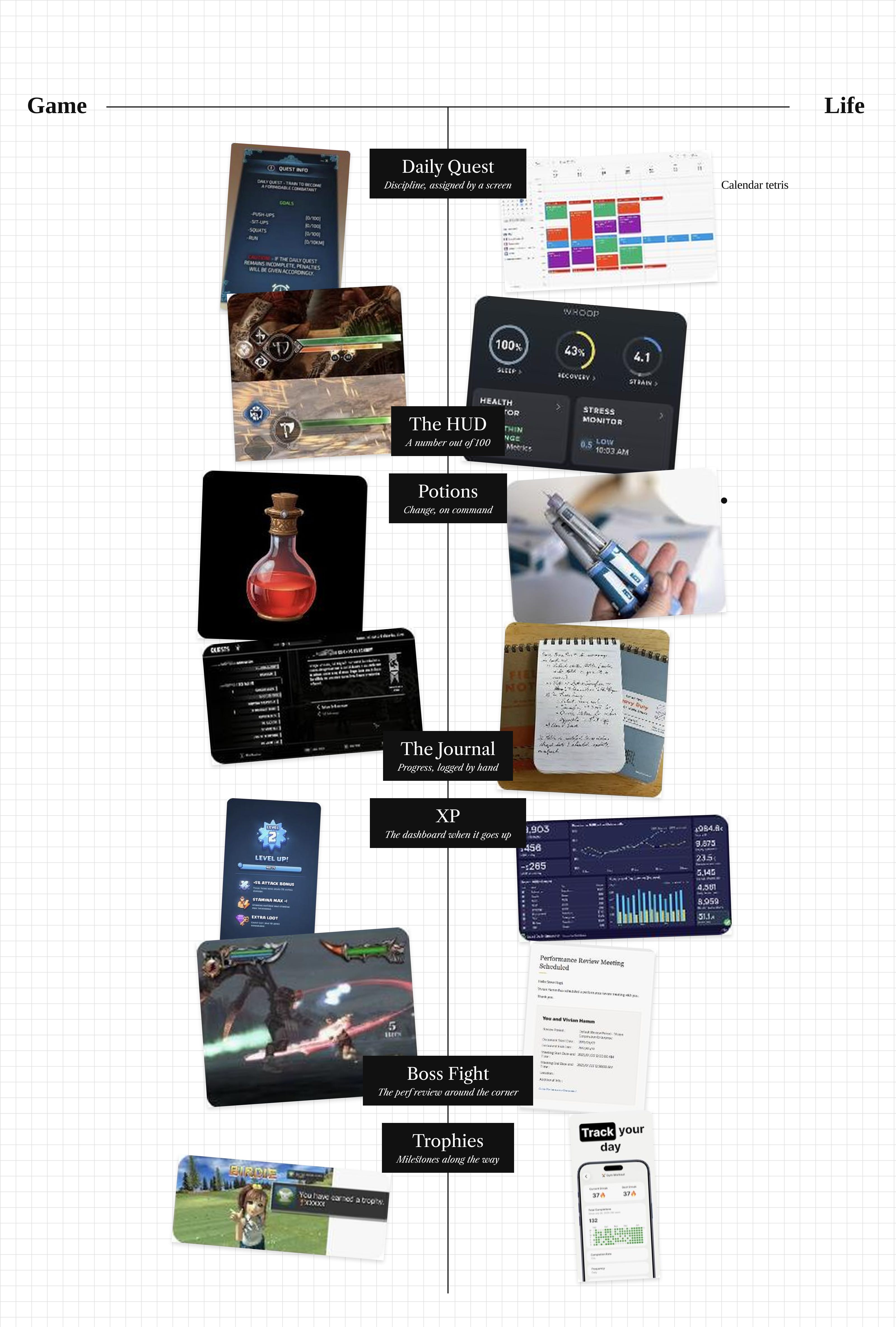
This is incredibly comforting short-term, and it helps you systemise quite a lot.
There’s something quite techno-humanist about this. Everything about us was mystical until a few centuries ago. We’ve now largely solved human physiology, and we’ve made a lot of progress on laying the foundations of mental health and establishing causal relationships between your past and your present trauma and identity. This is all phenomenal work, shedding light on what was once mystery. Are we this close to eliminating all mysticism about the human body? Physiologically speaking, it should be solved in the next 10 years. Psychologically speaking, you don’t really care, do you? Everything you want out of the body, its cognitive utility, its physical attraction, the upside it gives you in social dynamics and the workplace, can now be summoned on command using tiny little pulses.
The olden people just figured these things out instinctively, without needing a clear explanation. They did the thing and built conviction over their personal experience.
Your conviction, on the other hand, is completely murdered, because you don’t think you have the time to dilly-dally, especially when life is so short and you must achieve everything you need to in the next five years.
Back in the 1940s, if you were a bodybuilder, you were just that, a bodybuilder. The ability to be a polymath was scarce, especially for a non-elite who was worried about his everyday things. Your day would start at 6 or 7 am. You would travel for an hour, work, come back, get your groceries, eat, drink, go to sleep and repeat it all over again.
Today, you can get your groceries and your meals prepped in advance. You can measure every single calorie and macronutrient that goes into them while doing a high-tech job, still making it for padel at 7 am, and prepping for a Hyrox on the weekends. It is, technically speaking, feasible to have it all. You need to play some Tetris with a calendar, but you could make it work. At the very least, you log on to Instagram or Twitter and you see the people making it work. You see the investment banker friend of yours from college who’s now 10 times better than you, and you see people on Twitter who genuinely seem like they have 50 hours in a day. For the first time, you see a technical possibility of having it all across all areas of life, and you feel the desire to reach exactly towards that.
Today’s competitiveness happens on all fronts at the same time, far beyond the economic or the professional. It is no longer desirable to be a potbellied man making six figures wherever you live. You must now also have the social and the physical cachet to feel complete.
The life app is the biggest frontier
This all culminates in one super app, coming in the next decade. It will have everything you do at work, and everything you do personally, down to how you spend each second of your time. It will track everything, including your health vitals, what you do and how frequently. It will let you set milestones and define the key areas of your life, and it’ll give you a perfectly structured HUD and routine and, fuck it, even a health bar, if Zuck cracks AR glasses by then, which increasingly seems to be the case. And it will have a genie, an AI layer that ingests all of this and talks to you whenever you need.
Strictly speaking, the tech needed for this super app is 99% there. It just needs a concerted effort and large funding to gamify your whole life.
There’s no game where Kratos goes to herd cattle
I’ve played God of War and watched Solo Leveling, and interestingly, while you’re the incarnation of agency and act out the main character’s will, you don’t really get to decide or make choices. When you start God of War, you don’t choose whether you should kill Ares. The path is set, and you merely walk the path the game has already chosen for you. This is changing in modern games, because they foresaw this much earlier than me, but there’s still no game where you can forgive the entire Greek pantheon as Kratos and go herd cattle instead.
Games are great because there’s an external destination, and reaching it helps you be part of a story, and you take what you need out of it. There’s also a submission that this story is all you will have, and that this is indeed your story. Somewhere along the line, you must acknowledge that you never chose to play this game, and you play it anyway, unknowingly. You accepted somewhere along the line that if you’re going to play this game, and play it this way specifically, without retiring into the woods, you want to win.
Submitting your entire life, based on a few mimetic desires, to an external system will inevitably kill serendipity and judgement in your soul. You’ll be left an actor of desires that, once completed, will leave you with the same hollowness.
Outro
Julia Child was 36 when she ate her first proper French meal, a sole meunière in Rouen, on the day she landed in France with her husband in 1948. Before that she’d been an advertising copywriter and a typist turned researcher for the OSS during the war, and by her own account she couldn’t really cook. That one meal floored her. She enrolled at Le Cordon Bleu, spent years failing and fussing in her Paris kitchen, and more than a decade later co-wrote Mastering the Art of French Cooking and ended up on television, teaching America how to make an omelette. Nobody would’ve put cooking on her dashboard. There was no quest for it, no score, no five-year plan. She wandered into a restaurant hungry and followed the feeling all the way through.